

Millions of birds migrate through the Carolina Lowcountry every year.
On their transnational journeys, these birds of the wind depend on an interconnected web of wetlands and near-shore islands, especially here on the coast of South Carolina.
Birds and their natural homes, however, are facing extreme threats - from the accumulated impacts of sea-level rise, overdevelopment, and habitat loss.
To do our part, to help “bend the bird curve,” and save coastal birds, we created this Bird Island Research Directory (B.I.R.D.).
The B.I.R.D. project’s goal is to serve as a narrative guide and information platform, to encourage both old and new bird enthusiasts to work together for conservation.
Join The M.A.R.S.H. Project’ Eco-Corridor, in support of the birds! *Click!*
Join The M.A.R.S.H. Project’ Eco-Corridor, in support of the birds! *Click!*
-

Bird Key - Stono
𖦏 32.627947, -79.986239
Located at the mouth of the Stono Inlet between Folly, Kiawah, and Johns Islands, Bird Key–Stono is a dynamic seabird sanctuary, emblematic of the shifting sands and abundance of life that defines the South Carolina coast. -

Crab Bank
𖦏 32.778670, -79.884556
Crab Bank is one of South Carolina’s most “urban” yet productive seabird sanctuaries. The island is a living example of the possibilities of coastal restoration when community coalitions come together. -

Deveaux Bank
𖦏 32.550193, -80.181558
Located at the mouth of the North Edisto River, between Seabrook Island and Botany Bay, Deveaux Bank is one of the most ecologically significant seabird sanctuaries on the Atlantic Coast, especially for migratory shorebirds like whimbrel and red knot. -

Marsh Island
𖦏 32.989828, -79.551517
Situated within the protected estuarine landscape of Cape Romain National Wildlife Refuge, Marsh Island serves as one of the Lowcountry’s treasured nesting and resting habitats for seabirds and shorebirds. The island is centrally located in the 66,000 acre Cape Romain refuge, which is listed as a UNESCO Biosphere Reserve and as a Site of International Importance in the Western Hemisphere Shorebird Reserve Network (WHSRN). -
Tomkins Island
𖦏 32.059429, -80.868512
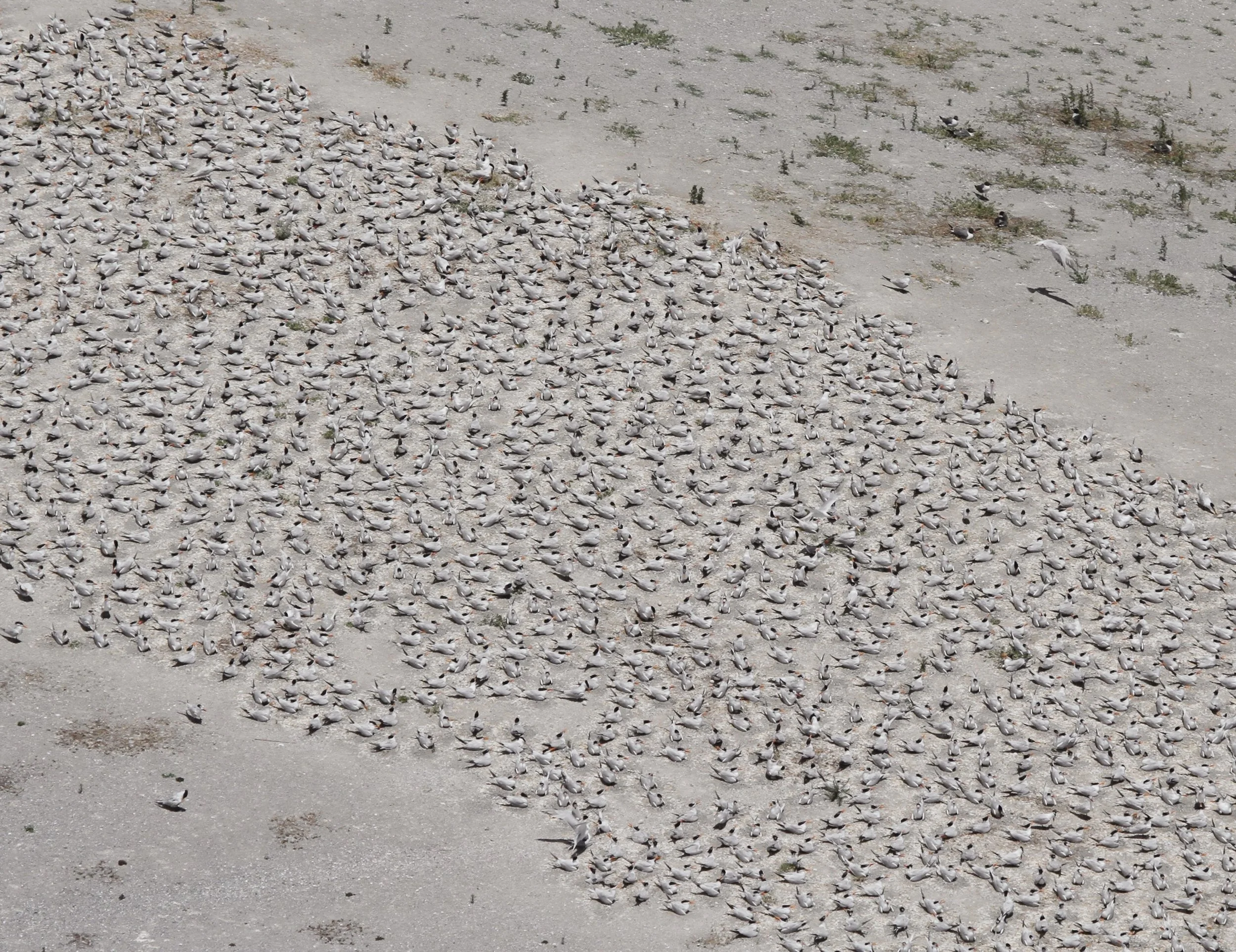
Tomkins Island is proof that people can build islands for coastal bird habitat. This protected seabird sanctuary, at the mouth of the Savannah River, between South Carolina and Georgia, was constructed from dredge spoil during the Savannah Harbor Expansion project. Closed year-round to visitors, the island now serves as an essential nesting and roosting site for seabirds and shorebirds, such as terns and pelicans.
Support conservation with Coastal Expeditions Foundation, and go see the birds! *Click!*
Support conservation with Coastal Expeditions Foundation, and go see the birds! *Click!*
The Bird Island Research Directory emerged through a partnership with the 🍏 College of Charleston, 🌊 Coastal Expeditions Foundation, 🌱 The M.A.R.S.H. Project and the 📎 SC Office of Resilience, thanks to a grant from the National Fish and Wildlife Foundation.
B.I.R.D.’s aim is to highlight ongoing community efforts to study, understand, and protect bird island habitats along the Carolina coast. This interdisciplinary guide brings together the research of biologists and scientists, professors, students, community members, and artists in support of environmental conservation, through the life-histories and stories of the Lowcountry’s diverse coastal birds.


⛶ Vincent J. Musi for SCDNR